
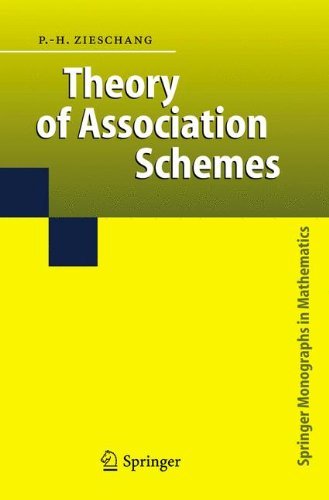
Theory of Association Schemes (Springer Monographs in Mathematics)
Product details
| Management number | 231932523 | Release Date | 2026/06/18 | List Price | US$27.32 | Model Number | 231932523 | ||
|---|---|---|---|---|---|---|---|---|---|
| Category | |||||||||
The present text is an introduction to the theory of association schemes. We start with the de?nition of an association scheme (or a scheme as we shall say brie?y), and in order to do so we ?x a set and call it X. We write 1 to denote the set of all pairs (x,x) with x? X. For each subset X ? r of the cartesian product X×X, we de?ne r to be the set of all pairs (y,z) with (z,y)? r.For x an element of X and r a subset of X× X, we shall denote by xr the set of all elements y in X with (x,y)? r. Let us ?x a partition S of X×X with?? / S and 1 ? S, and let us assume X ? that s ? S for each element s in S. The set S is called a scheme on X if, for any three elements p, q,and r in S, there exists a cardinal number a such pqr ? that|yp?zq| = a for any two elements y in X and z in yr. pqr The notion of a scheme generalizes naturally the notion of a group, and we shall base all our considerations on this observation. Let us, therefore, brie?y look at the relationship between groups and schemes. Read more
| ASIN | B000VHYK2Q |
|---|---|
| XRay | Not Enabled |
| ISBN13 | 978-3540305934 |
| Edition | 2005th |
| Language | English |
| File size | 3.8 MB |
| Page Flip | Not Enabled |
| Publisher | Springer |
| Word Wise | Not Enabled |
| Print length | 300 pages |
| Accessibility | Learn more |
| Publication date | December 19, 2005 |
| Enhanced typesetting | Not Enabled |
Bestseller ranking
Advanced


Customers who viewed this product also viewed
Abstract

![Commutative Algebra (De Gruyter Textbook) [Print Replica] Kindle Edition](https://m.media-amazon.com/images/I/61n-yL38XpL.jpg)

Correction of product information
If you notice any omissions or errors in the product information on this page, please use the correction request form below.
Correction Request Form